

Search engine optimization is defined as the practice of building organic visibility that compounds over time, delivering qualified traffic and customer acquisition long after paid campaigns go dark. The role of SEO in long-term growth is not to generate a quick spike. It is to build an asset that grows in value every month you invest in it. Organic search drives 53.3% of all trackable website traffic, outperforming paid, social, email, and direct visits combined. That single figure tells you where your customers are finding businesses. A well-executed SEO program delivers a median ROI of 748% over three years, with first meaningful rankings appearing in 3–12 months. Businesses that treat SEO as infrastructure, not a line-item expense, are the ones that build durable revenue.
What measurable impact does SEO have on long-term growth?
The numbers behind SEO’s impact on traffic, conversions, and revenue are not marginal. They are category-defining.
Organic search converts at rates up to 4x higher than paid channels. The reason is intent. A person who types “emergency plumber Dundalk” into Google is already in buying mode. A paid ad interrupts someone who may not be. Organic search captures demand that already exists. Paid search tries to create it.

| Channel | Traffic share | Conversion advantage | Cost over time |
|---|---|---|---|
| Organic search | 53.3% of all web traffic | Up to 4x vs. paid | Decreases as authority grows |
| Paid search | Immediate but limited | Lower intent-match rate | Increases with competition |
| Social media | Declining organic reach | Low purchase intent | Requires constant spend |
| Existing audience only | High for warm lists | Dependent on list size |
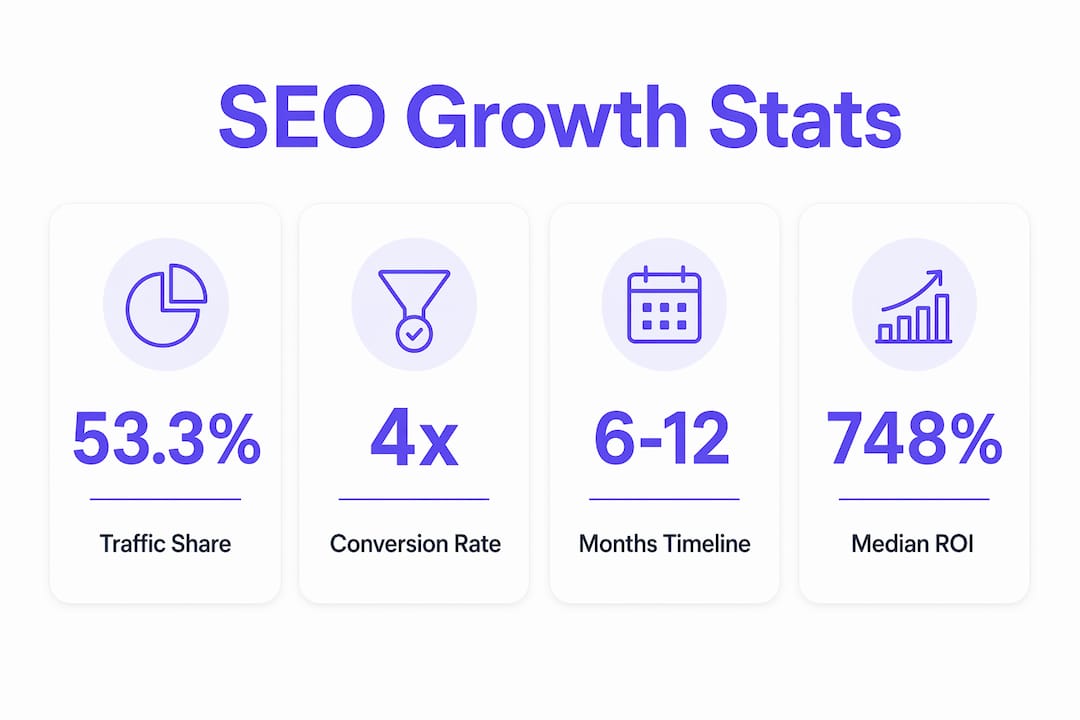
Ranking improvements typically begin 3–12 months after launching a campaign. That timeline frustrates business owners who expect immediate results. The patience required is exactly why SEO creates a competitive moat. Most businesses quit before the returns arrive.
Pro Tip: Track leading indicators from month one: crawl coverage, indexed pages, and keyword position movement. These signals confirm your program is working before revenue numbers shift.
How has SEO evolved in 2026 to support sustainable growth?
SEO in 2026 is no longer a keyword-stuffing exercise. It is a multi-surface content system designed to capture demand wherever customers search.
Modern SEO targets multiple discovery surfaces, including AI overviews, voice search, Google’s Shopping Graph, and traditional blue-link results. A blog post that earns an AI overview citation reaches users who never click a traditional result. That is a new category of visibility that did not exist three years ago. Businesses that write authoritative, well-structured content now appear across all of these surfaces simultaneously.
The shift in execution looks like this:
- Audit existing content first. Identify pages that once ranked but have slipped. These are your highest-priority assets.
- Update underperforming pages every 90–180 days. Refreshing existing content recaptures lost traffic faster than publishing new articles alone.
- Build topical authority, not just individual keywords. Google rewards sites that cover a subject comprehensively, not sites that target one phrase.
- Fix technical foundations before scaling content. Slow load times, broken internal links, and poor mobile experience cancel out good content.
- Integrate SEO across teams. Content writers, developers, and analytics teams must operate from the same keyword and conversion data.
The businesses winning in organic search treat SEO as an operating system, not a campaign. Content, development, and analytics run together on a shared calendar. That cross-team model is what separates durable growth from short-term traffic bumps.
Pro Tip: Use Google Search Console’s “Queries” report finding pages ranking in positions 8–20. These are your fastest wins. A targeted content update often moves them into the top five within 60 days.
Why does SEO outperform paid advertising over time?
Paid advertising delivers traffic the moment you fund it and stops the moment you don’t. SEO builds equity that keeps working.
Every piece of content you publish, every backlink you earn, and every technical improvement you make adds to your domain’s authority. That authority does not disappear when you pause a campaign. It compounds. A page that earns 50 backlinks this year will likely rank higher next year, even if you publish nothing new. That is the core difference between renting visibility and owning it.
“SEO builds compounding assets in content, authority, and rankings that grow over years. Paid media stops driving traffic the instant the budget ends. Businesses that treat SEO as infrastructure rather than a subscription unlock equity that paid channels can never replicate.”
The ROI hockey stick pattern is real. Months 1–6 feel invisible. You are building crawl coverage, earning early links, and fixing technical issues. Months 7–12 show measurable ranking movement. Months 12–24 deliver the compounding returns that make the early investment look cheap in hindsight.
Businesses that abandon SEO during the first six months make the most expensive mistake in digital marketing. They pay for all the foundational work and collect none of the returns. The compounding growth starts after that foundational period ends. Quitting early is the equivalent of canceling a savings account the month before compound interest kicks in.
Paid search has a legitimate role. Astorymedia uses Google Ads management alongside SEO for clients who need immediate lead flow while organic rankings build. The two channels are not competitors. They serve different time horizons. The mistake is treating paid search as a permanent substitute for organic authority.
How do you build and sustain a long-term SEO strategy?
A long-term SEO program follows a predictable sequence. Businesses that understand the timeline set realistic expectations and stay the course.
- Months 1–3: Fix the foundation. Conduct a full technical audit. Resolve crawl errors, improve page speed, and fix mobile usability issues. Without a clean technical base, content investment is wasted.
- Months 3–6: Build baseline content. Publish authoritative pages targeting your core service keywords. Focus on search intent, not word count. A 600-word page that directly answers a specific question outperforms a 3,000-word page that wanders.
- Months 6–12: Optimize and expand. Update early content based on Search Console data. Add internal links between related pages. Begin earning backlinks through digital PR, partnerships, and original research.
- Month 12 onward: Compound. Rankings stabilize and grow. Traffic increases without proportional increases in effort. This is where the 748% median ROI begins to materialize.
SEO only pays off when three conditions are met: your audience is actively searching for what you offer, you produce genuinely useful content, and you commit to the timeline. Skip any one of these and results stall.
Measurement matters throughout every phase. Track keyword position movement, organic sessions, and conversion rate from organic traffic. Do not rely on head-term rankings alone. Long-tail keywords, featured snippet captures, and local SEO visibility often drive more revenue than a single competitive keyword.
Pro Tip: Never reallocate your SEO budget to paid campaigns during a slow month. The first six months are the most expensive to abandon. The cost of restarting from zero is always higher than the cost of staying consistent.
Key Takeaways
SEO is the only digital marketing channel that builds compounding equity, delivering higher traffic, better conversion rates, and lower acquisition costs the longer you invest in it.
| Point | Details |
|---|---|
| Organic traffic dominates | Organic search drives 53.3% of all web traffic, more than paid, social, and email combined. |
| Conversion advantage is real | Organic search converts at up to 4x the rate of paid channels by capturing high-intent demand. |
| ROI compounds over years | A well-run SEO program delivers a median 748% ROI over three years, with returns accelerating after month 12. |
| Content updates beat new content | Refreshing existing pages every 90–180 days recaptures lost rankings faster than publishing new content alone. |
| Patience is the strategy | Businesses that abandon SEO before month 12 pay for all the foundational work and collect none of the returns. |
Why I think most businesses misunderstand what SEO actually is
Most business owners I speak with think of SEO as a service they buy, use for a few months, and then evaluate. That framing is the root cause of most SEO failures.
SEO is infrastructure. It is closer to building a road than running a sale. You do not build a road, use it for six months, and then tear it up because the traffic count was lower than expected. You build it, maintain it, and watch it carry more traffic every year as more people discover it exists.
The businesses I have seen succeed with SEO share one trait. They measure the right things early. They track crawl coverage, indexed pages, and keyword position movement in months 1–6, not revenue. Revenue is a lagging indicator. By the time it moves, the foundational work is already months old.
The businesses that fail share a different trait. They expect SEO to behave like paid advertising. When the first month produces no leads, they reallocate the budget. They have essentially paid for the foundation of a building and then walked away before the walls went up.
Sustainable growth requires treating your content and domain authority as assets on a balance sheet. They appreciate over time. They protect you from algorithm changes better than any short-term tactic. And they keep working on weekends, holidays, and every hour you are not running a paid campaign.
— Astory
How Astorymedia builds SEO programs that last
Astorymedia works with Irish businesses that are ready to treat SEO as a long-term investment, not a one-off project. The agency’s approach combines technical SEO, content strategy, and local search optimization into a single program designed to deliver compounding returns over 12–36 months.
Every client engagement starts with a full technical audit and a content gap analysis. From there, Astorymedia builds a phased plan that aligns with realistic timelines and measurable milestones. The agency’s SEO services in Dundalk cover everything from on-page optimization and site architecture to link building and ongoing content updates. For businesses that need local visibility alongside broader organic growth, Astorymedia’s local SEO program targets the searches that drive foot traffic and regional enquiries. Contact Astorymedia to build an SEO program that grows in value every month.
FAQ
What is the role of SEO in long-term business growth?
SEO builds organic search visibility that compounds over time, delivering qualified traffic and higher conversion rates without ongoing ad spend. It functions as a durable business asset, not a temporary campaign.
How long does SEO take to show results?
First meaningful rankings typically appear within 3–12 months. Consistent revenue impact usually follows at the 6–12 month mark, with compounding returns accelerating after month 12.
How does SEO compare to paid advertising for ROI?
A well-executed SEO program delivers a median ROI of 748% over three years. Paid advertising stops driving traffic the moment the budget ends, while SEO equity continues to grow.
Why do businesses fail at SEO?
Most businesses abandon SEO during the first 6 months before compounding growth begins. They pay for all the foundational work and collect none of the returns because they quit too early.
How often should existing content be updated for SEO?
Updating existing content every 90–180 days recaptures lost rankings faster than publishing new content alone. Focus updates on pages that once ranked well but have declined in position.


