

Marketing-business alignment is defined as the practice of designing every marketing activity to directly support your company’s strategic priorities and financial targets. When marketing operates without this connection, budgets get spent on campaigns that generate traffic but not revenue. Aligned strategies fuel revenue growth by 24% and increase profits by 27%. Those numbers reflect a simple truth: marketing that serves the business plan produces results that marketing built in isolation never will. This guide gives you a practical framework to align marketing with business goals, from setting the right foundations to tracking the metrics that actually matter.
What does it take to align marketing with business goals?
Alignment starts before you write a single campaign brief. You need a clear picture of where the business is going before marketing can support the journey.
Understand the business first
Marketing plans built from business plans outperform those built alongside them. Marketing leaders must understand financial targets and translate them into marketing priorities. That means reading the annual plan, sitting in on finance reviews, and knowing the revenue targets by quarter, not just by year. Without that context, marketing teams default to activity metrics like impressions and clicks that rarely connect to commercial outcomes.

Involve the right people early
Cross-functional involvement is not optional. Sales, finance, and product teams each hold information that shapes what marketing should prioritize. Sales knows which customer segments close fastest. Finance knows where margin is highest. Product knows what is coming to market and when. Bringing these teams into planning early surfaces tensions before they become expensive mistakes.
Pro Tip: Schedule a 90-minute alignment session with sales and finance at the start of each planning cycle. Use it to agree on the top three commercial priorities marketing will support that quarter.
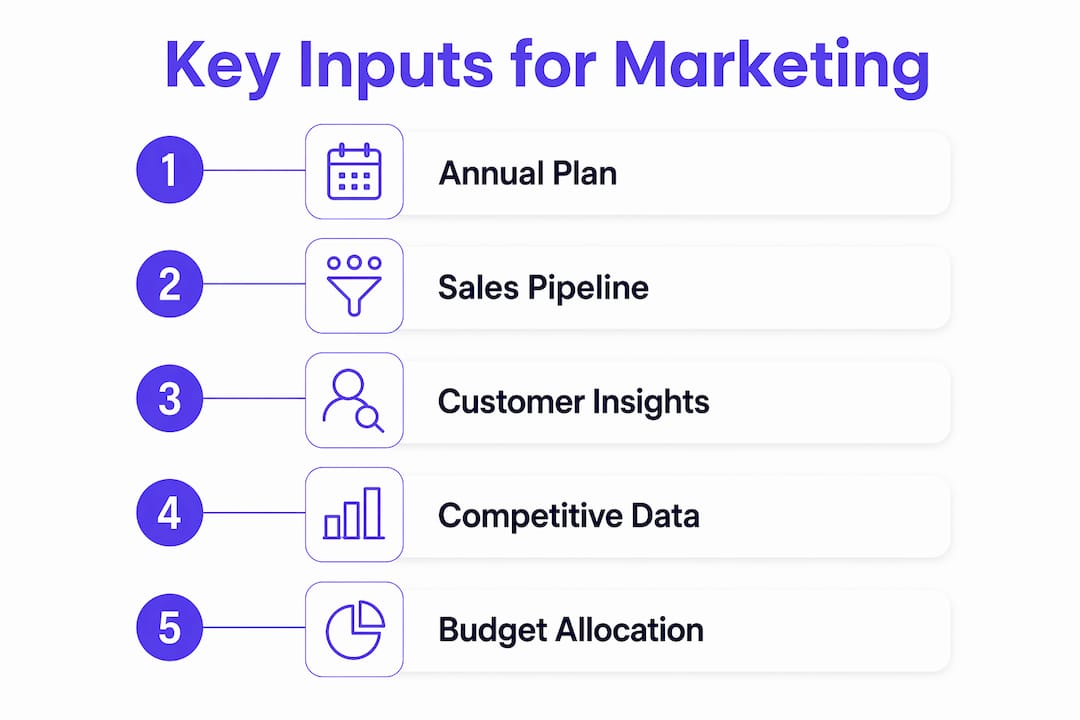
Key inputs for marketing-business alignment
The table below outlines the core tools and data inputs you need before building a marketing plan.
| Input | Purpose |
|---|---|
| Annual business plan | Sets revenue targets and growth priorities |
| Sales pipeline data | Identifies which segments and offers need support |
| Customer retention metrics | Reveals where churn risk is highest |
| Profit and loss summary | Shows which products or services drive margin |
| Brand positioning document | Keeps messaging consistent with company identity |
Marketers who document their strategy are 313% more likely to report success. Documentation is not a formality. It is the mechanism that keeps marketing accountable to the business plan rather than drifting toward whatever feels creative in the moment.
How do you translate business objectives into marketing goals?
Business objectives are written in financial language. Marketing goals need to be written in measurable activity language. The SMART framework bridges that gap.
SMART stands for Specific, Measurable, Achievable, Relevant, and Time-bound. Applying SMART goals to digital marketing translates abstract business aims into concrete marketing actions. A business objective like “grow revenue by 20% this year” becomes a SMART marketing goal when you specify which channel, which audience segment, and which conversion metric will move that number.
A step-by-step process for goal translation
-
Start with the business objective. Write it down exactly as the leadership team stated it. “Increase new customer revenue by €500,000 in 2026” is a business objective.
-
Identify the marketing lever. Decide which marketing activity most directly drives that outcome. For new customer revenue, the lever is usually lead generation or conversion rate improvement.
-
Set a SMART marketing goal. Convert the lever into a goal with a number and a deadline. “Generate 200 qualified leads per month through organic search by Q3 2026” is a SMART marketing goal.
-
Map the KPIs. Choose two or three metrics that prove the goal is on track. For the example above, those KPIs might be organic sessions, lead form submissions, and cost per lead.
-
Check relevance. Ask whether hitting this marketing goal actually moves the business objective. If the answer is unclear, the goal needs to be rewritten.
-
Document and share. Write the goal, the KPIs, and the owner’s name in a shared document. Undocumented goals get abandoned when priorities shift.
Pro Tip: Run every proposed marketing goal through this test: “If we hit this goal and nothing else changes, does the business objective move?” If the answer is no, the goal is not aligned.
The most common mistake at this stage is setting marketing goals that measure effort rather than outcomes. Publishing 20 blog posts per month is an effort metric. Generating 150 inbound leads per month from content is an outcome metric. Business leaders respond to outcome metrics because they connect directly to revenue.
What strategies actually integrate marketing with business goals?
Knowing the goals is not enough. You need a planning and execution process that keeps marketing connected to business priorities week by week, not just at the annual planning retreat.
Build the plan collaboratively
Collaborative planning with sales, product, and finance creates shared accountability and more effective marketing plans. When each department contributes to the marketing plan, they also take ownership of its success. That shared ownership changes how teams behave when campaigns underperform. Instead of pointing fingers, they problem-solve together.
Allocate budget from commercial targets
Most marketing budgets get set as a percentage of last year’s spend. That approach disconnects budget from strategy. The better method is to start with the commercial target, calculate what it will take to reach it, and build the budget from there. Early involvement in financial planning lets marketing shape realistic budgets and goals rather than inheriting numbers that do not match the ambition.
Measure and report on outcomes
Quarterly reporting is the mechanism that keeps alignment alive after the planning phase ends. Quarterly marketing outcome reporting maintains alignment and prevents executive disengagement. A quarterly review should answer three questions: Did marketing hit its goals? Did those goals move the business objective? What needs to change next quarter?
The table below compares two common implementation approaches and their practical trade-offs.
| Approach | Strength | Limitation |
|---|---|---|
| Annual plan with quarterly reviews | Provides stability and clear direction | Can be slow to respond to market shifts |
| Rolling 90-day planning cycles | Keeps strategy current and responsive | Requires strong internal communication discipline |
Both approaches work. The right choice depends on how fast your market moves and how mature your internal planning process is.
- Assign a named owner to every marketing KPI.
- Review performance data monthly, not just quarterly.
- Connect every campaign brief to a specific business objective before approving spend.
- Use a shared dashboard that both marketing and sales teams can access.
What are the most common pitfalls in marketing alignment?
Alignment fails in predictable ways. Recognizing the patterns early saves significant time and budget.
Misreading the business priority. Marketing teams sometimes optimize for the metric they can move fastest, not the one the business needs most. A company trying to reduce churn does not need more top-of-funnel awareness campaigns. It needs retention-focused content and customer success messaging. Always confirm the priority directly with the leadership team before building the plan.
Tracking the wrong metrics. Poor alignment between sales and marketing causes teams to grow 58% slower and experience 72% higher customer churn. Tracking vanity metrics like social media followers while churn rises is a direct symptom of this problem. Every metric on your dashboard should have a clear line to a business outcome.
Siloed communication. Marketing decisions made without sales input produce campaigns that attract the wrong buyers. Sales decisions made without marketing input produce messaging that contradicts the brand. Weekly or biweekly syncs between marketing and sales are not overhead. They are the minimum communication needed to keep both teams working toward the same goal.
- Hold a standing 30-minute weekly sync between marketing and sales leads.
- Share the marketing calendar with the full commercial team at least four weeks in advance.
- Report marketing outcomes in the same language finance uses, meaning revenue and pipeline, not reach and engagement.
Pro Tip: Present marketing results in financial terms at every executive meeting. “We generated €120,000 in pipeline from content this quarter” lands differently than “We published 15 blog posts.” Finance-friendly reporting builds credibility and protects your budget.
Key Takeaways
Marketing aligned to business goals consistently outperforms marketing built on creative instinct alone, because it connects every campaign to a measurable commercial outcome.
| Point | Details |
|---|---|
| Document your strategy | Documented strategies are 313% more likely to succeed than undocumented ones. |
| Use SMART goals | Translate every business objective into a specific, measurable marketing goal with a deadline. |
| Involve cross-functional teams | Sales, finance, and product input makes marketing plans more accurate and more accountable. |
| Budget from targets | Build marketing budgets from commercial goals, not from last year’s spend. |
| Report in financial terms | Quarterly outcome reporting keeps executives engaged and marketing budgets protected. |
What I’ve learned about alignment after working with Irish businesses
Most marketing teams I work with are not failing because they lack creativity or technical skill. They are failing because no one ever sat them down with the annual business plan and said, “This is what we need marketing to do.”
The gap is almost always a communication gap, not a capability gap. Marketing professionals are often excluded from financial planning conversations, then handed targets that were set without their input. That sequence produces frustration on both sides. Marketing feels undervalued. Leadership feels let down. The fix is structural: get marketing into the room when targets are being set, not after.
The second thing I have noticed is that alignment is not a one-time event. A business that sets goals in january and reviews them in december is not aligned. It is just organized. Real alignment requires monthly check-ins, honest reporting, and the willingness to change the plan when the market changes. The businesses that do this well treat their marketing plan as a living document, not a filed PDF.
The third insight is about credibility. When marketing speaks in revenue terms, it earns a seat at the table. When it speaks only in reach and engagement terms, it gets treated as a cost center. The shift is simple but powerful: report what marketing contributed to pipeline and revenue, every single time.
— Astory
How Astorymedia helps you connect marketing to real growth
Astorymedia works with Irish businesses that want marketing to produce measurable commercial results, not just website traffic. Every engagement starts with understanding your business targets, then building a plan that connects those targets to specific marketing activities.

Whether you need SEO services that drive qualified leads from organic search, paid advertising through Google Ads management tied to specific revenue goals, or a website built to convert visitors into customers, Astorymedia structures every service around your commercial priorities. One client came to Astorymedia with an outdated e-commerce site generating minimal revenue. After rebuilding the site and aligning the digital strategy to their sales targets, that business now generates €40,000 monthly. That is what marketing aligned to business goals actually looks like in practice. Visit Astorymedia’s full services to see how each offering connects to your growth targets.
FAQ
Why do business goals drive marketing plans?
Business goals define what the company needs to achieve commercially. Marketing plans built from those goals direct budget and effort toward activities that move revenue, not just metrics.
What is the SMART framework in marketing?
SMART stands for Specific, Measurable, Achievable, Relevant, and Time-bound. It converts broad business objectives into concrete marketing goals with clear success criteria.
How does poor alignment affect business performance?
Teams with poor marketing and sales alignment grow 58% slower and experience 72% higher customer churn than aligned teams. Misalignment wastes budget and reduces revenue predictability.
What marketing performance metrics matter most?
The metrics that matter most are those with a direct line to revenue: qualified leads generated, pipeline value attributed to marketing, customer acquisition cost, and retention rate. Reach and engagement metrics only matter when they connect to one of these outcomes.
How often should marketing strategy be reviewed?
Quarterly reviews are the minimum for maintaining alignment. Fast-moving markets benefit from monthly check-ins that compare marketing performance against commercial targets and adjust priorities accordingly.


