
If you listen to most online “SEO experts”, they’ll tell you to open your wallet, hire a cheap outreach team on a freelancing platform and buy hundreds of backlinks.
I tried that, and it almost destroyed my website.
I’ve been working in marketing and SEO for over 13 years. I studied computer science and coding at National College of Ireland, Atlantic Technological University Sligo and Dublin Business School, and the rest I learned by testing things in the field. What I found is that SEO comes down to real relationships with people, strict quality control and doing the work consistently.
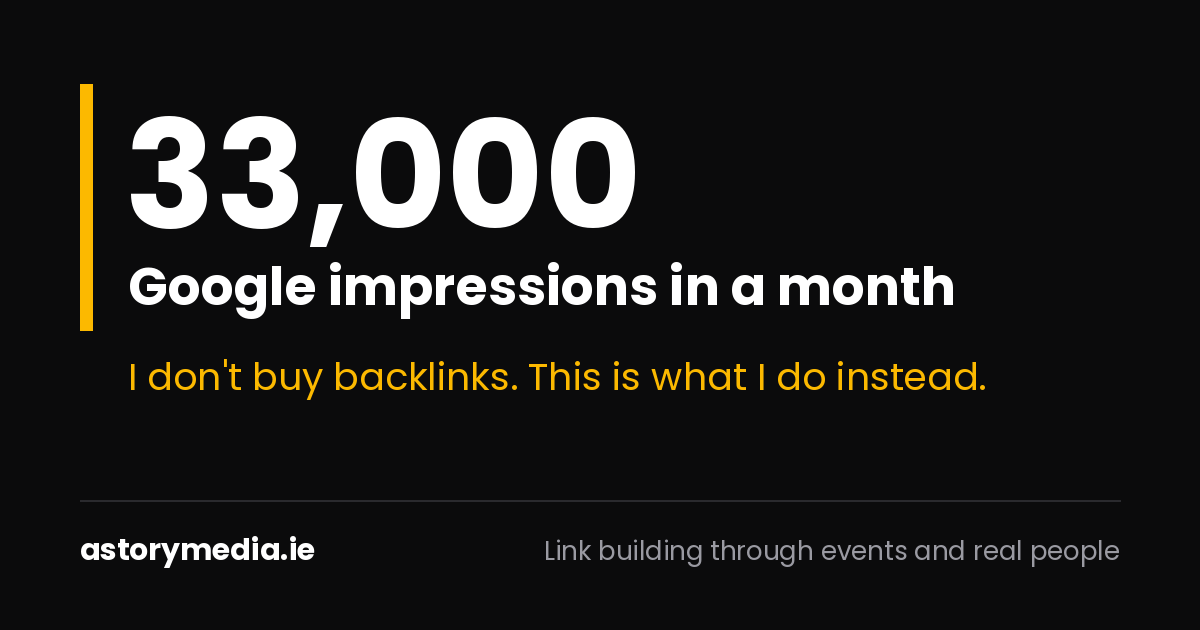
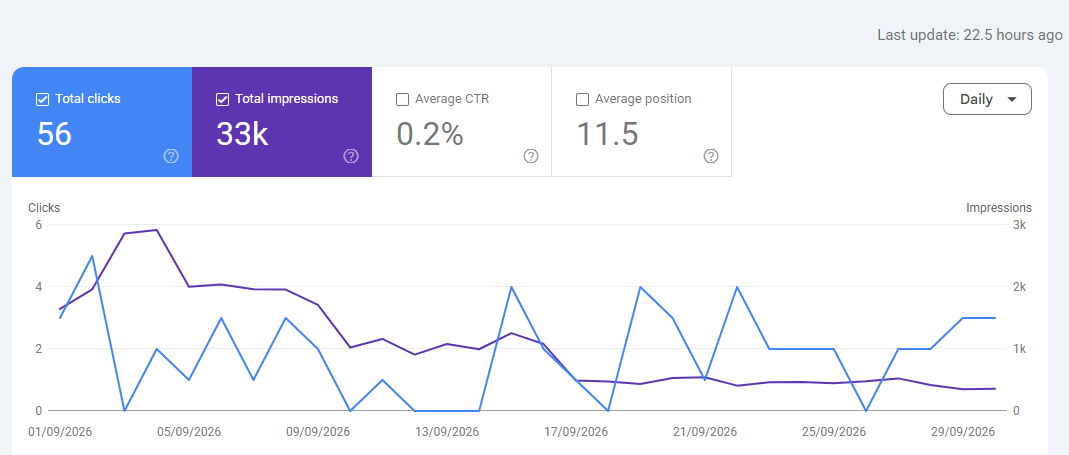
In September 2026 my website showed up over 33,000 times in Google search results. I’m not going to pretend that’s 33,000 visitors, because impressions and clicks are two different things, and the clicks are still small. I don’t buy backlinks and I don’t sell them. What I do is simple. I write content, like my guide to how affiliate marketing works in Ireland, I go to places, I meet people, I write about them on my website, and many of them link back to me from theirs. It builds slowly, but it keeps building.
This is how I do it.
1. I start at events, not behind a screen
Most people assume link building starts behind a computer screen. Mine starts at events.
I go to an event at least once a week. It could be a big business expo like the RDS Business Expo in Dublin, or a music event where I end up talking to musicians, authors and artists. At a business event you meet vendors and all types of businesses. At a music event you meet musicians. They all have a website or need one, and they all need to be found online.
Some of the people I’ve met are very well known here in Ireland. I know the man behind Mythical Ireland personally, and Jim Fitzpatrick, the artist behind the famous Che Guevara image, and I’ve done some work with them as well.
Where I find events
- Facebook Events and local groups. Search for meetups in your industry, like photographer meetups or small business roundtables.
- Ticketing platforms like Eventbrite, Ticket Tailor and Ticketmaster. People think Ticketmaster is only for concerts, but I’ve been to business events that were sold through it, and the music events are worth going to as well.
- Local classifieds and directories. Platforms like Gumtree regularly list local business group meetings.
How I ask for a collaboration
When you meet business owners at these events, don’t ask for a favour right away. People love talking about their own businesses, so give them the space to do it.
- Start with your phone. Ask if they have a website or a blog.
- Offer something first. I say something like, “I’d love to write an honest, positive feature about your business on my blog and link directly to you.”
- Once the piece is published, show it to them and ask if they’d be open to mentioning it or linking to it from their own website.
2. What happened when I bought cheap backlinks
When I was first building my own website, I fell for the quick fix. I bought cheap backlink packages from platforms like Upwork, Fiverr and foreign job boards.
On the surface it looked great. The sellers sent neat screenshots showing hundreds of links created for a few dollars. It was a disaster.
- Many of these sellers use automated link farms across unrelated countries, and they reuse the same spammy domains over and over again.
- Don’t trust the screenshots a seller sends you. Run your own check in Ahrefs, Semrush or Moz to see where the links actually come from. Keep in mind that the toxicity and spam scores in those tools are their own estimates, not something Google uses.
- Google is good at spotting unnatural bursts of links from spam networks. Most of the time it simply ignores them, so you’ve paid for nothing. In worse cases, buying links breaks Google’s spam policies and can lead to a manual action, which can push your pages down or out of the results.
You don’t need thousands of backlinks. One or two good, contextual links from genuine local or industry-relevant websites will do more for your rankings than 5,000 links from a farm.
3. Local outreach with Google Maps
If you can’t get to an event this week, your best tool is already open on your screen: Google Maps.
- Open Google Maps and search for complementary businesses in your region. If you’re a web designer, that could be local photographers, copywriters or plumbers.
- Call or email the business owner directly.
- Tell them you’re putting together a local guide or resource page and you’d like to feature their business with a direct link to their website.
It takes effort and you have to be prepared for rejection, but a local business owner is far more likely to open your email than a faceless webmaster on the other side of the world.
4. The two types of people you meet
When you network, both online and at events, you’ll run into two types of people. The first are warm and open, genuine business owners who are ready to exchange value and collaborate. The second are the show-offs, who are only there to boast about their success or their domain metrics.
I don’t think you should dismiss the show-offs. Their attitude might be off-putting, but watch what they’re doing. Their strategy might point to an industry trend, a venue or a type of content you’re overlooking. Learn from what works for them, but check that their practices are genuine before you copy anything.
5. Content quality and original photos
When you write about someone, or write a guest piece for another website, don’t cut corners on the content or the visuals.
Use your own photos from the event or the meeting whenever you can. Google has said for years that it doesn’t use EXIF data (the camera and location details saved inside a photo) for ranking, so I don’t waste time geotagging images. What Google does read is the alt text, the file name and the text around the image. The only embedded data it says it picks up is IPTC (creator, credit and copyright), and that is for showing image credits, not for rankings. Original photos still matter because they’re unique and they show you were actually there.
If you use AI tools like ChatGPT or Midjourney for featured graphics, make sure they’re unique, relevant and well designed, and never the generic stock imagery that appears on hundreds of other websites.
The short version
- Stop looking for automated shortcuts. Consistency beats laziness every time.
- Go to one local event a week. Check Facebook Events, Eventbrite, Ticketmaster or expos like the RDS.
- Start with people you already know. Feature them and build from there.
- Aim for one or two solid, relevant links at a time, not hundreds.
- Check where your links actually come from. Google says most sites never need the disavow tool; it’s meant for sites that bought links (like I did) or have a manual action.
I run Astory Media, a digital marketing and SEO agency in Dundalk. You can see what we do on the services page, and if you want to talk about your own website, you can contact me here.


