
You've got products. You've got a site. You might even be running Google Ads, posting on Instagram, and sending the odd email campaign. Still, sales feel stuck. Traffic comes in, some people browse, most leave, and every month you're left wondering whether the problem is your offer, your website, your ads, or the agency you're thinking about hiring.
That's where most owners get burned. They don't lose money because they hired help. They lose money because they hired the wrong kind of help. A slick pitch, vague reports, nice-looking mockups, and no real movement in revenue.
Hiring e commerce agencies can work very well. It can also become a slow, expensive leak if you don't know what you're buying. The difference usually comes down to one thing. Does the agency act like a growth partner, or just a task factory?
Table of Contents
- Stop Wasting Money on a Broken Online Store
- What E-commerce Agencies Actually Sell
- How to Spot a Winner or a Loser in 5 Minutes
- The Only Questions You Need to Ask an Agency
- E-commerce Agency Pricing Explained
- Your Next Move to Grow Your E-commerce Business
Stop Wasting Money on a Broken Online Store
Most online stores don't have a traffic problem first. They have a system problem.
The homepage is cluttered. Product pages are weak. Mobile feels awkward. Checkout asks for too much. Ad traffic lands on pages that weren't built to convert. Then the owner assumes the answer is “more marketing”. It usually isn't. It's fixing the machine before pouring more fuel into it.

If you sell in Ireland, this matters even more now. Ireland's e-commerce market has shifted from a side channel to a core route for retail and service sales, and the wider benchmark is brutal. The worldwide e-commerce total is projected to reach $6.86 trillion in 2025, while conversion rates are 3x higher for e-commerce sites that load in 1 second according to this e-commerce agency scaling breakdown. That means customers aren't comparing your site to the shop down the road. They're comparing it to the fastest, easiest buying experiences they use every week.
Your website is either helping sales or blocking them
A lot of owners think hiring an agency means buying a prettier site.
Wrong.
You're hiring someone to remove friction. That could mean speeding up the site, tightening product messaging, rebuilding category pages, fixing tracking, simplifying checkout, or aligning SEO and Google Ads so traffic lands on pages that match buyer intent. If those pieces are disconnected, your store leaks money.
Practical rule: Don't hire an agency because your site looks old. Hire one because your current setup fails to turn attention into revenue.
A useful side read here is this Sight AI white label SEO guide. Not because you need white label SEO specifically, but because it helps you understand how SEO delivery gets structured behind the scenes. That matters when an agency promises “full service” and you're trying to work out the extent of their control.
The real risk is not the fee
The primary risk is paying for activity with no commercial impact.
You can survive a bad design draft. You can't keep funding ads into a weak store, accepting reports full of impressions and clicks while sales stay flat. Good e commerce agencies know that. They talk about speed, user experience, conversion tracking, revenue per visitor, and what happens after the click.
Use that as your filter. If the conversation starts and ends with deliverables, keep walking.
What E-commerce Agencies Actually Sell
Most agencies list services like they're reading a takeaway menu. SEO. PPC. CRO. Email. Content. Web design. Feed management. Analytics.
That list is fine, but it hides the only thing you should care about. You are not buying services. You are buying outcomes.
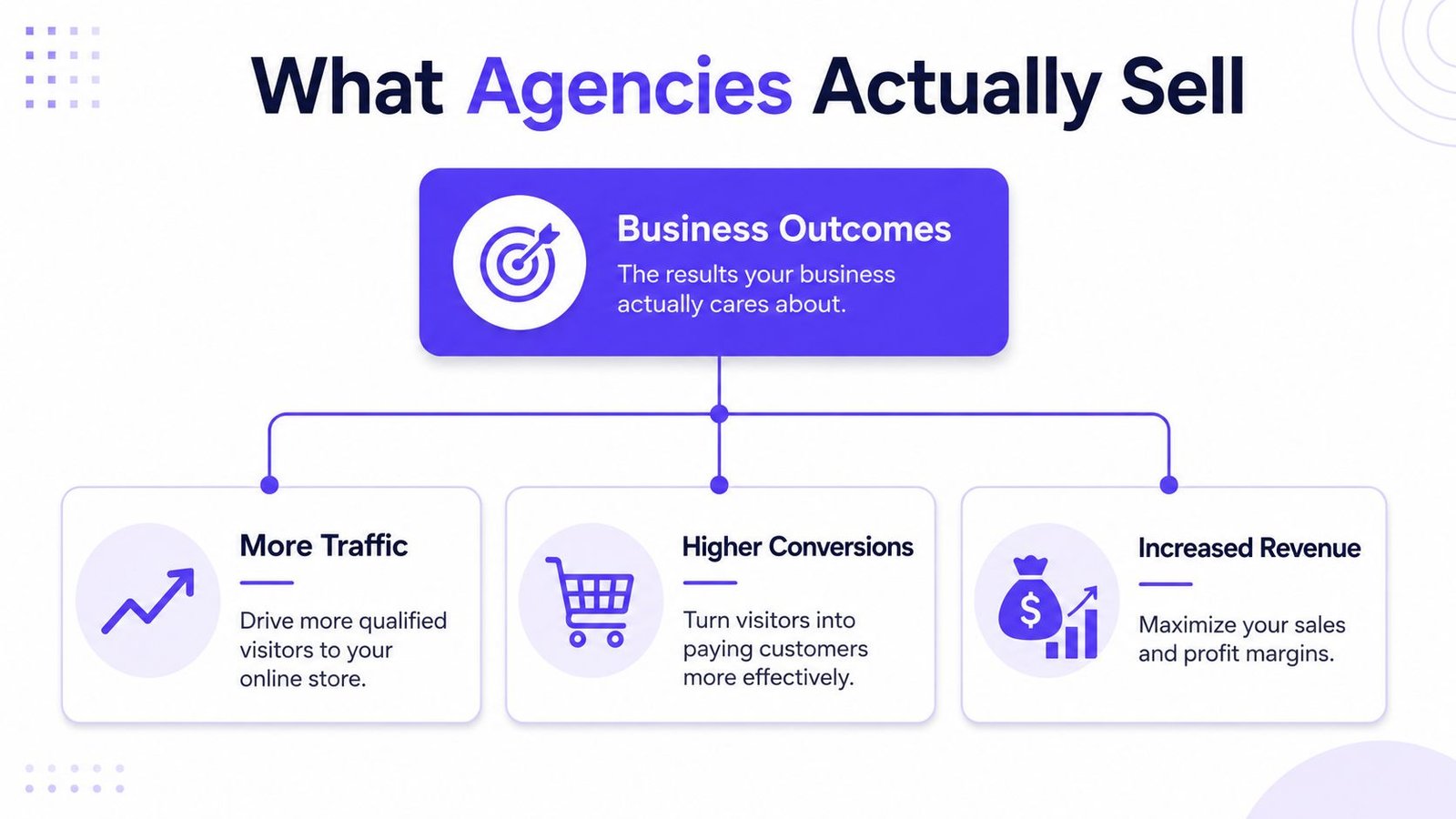
The post-pandemic shift changed the job completely. Digital buying behaviour accelerated, buyers got used to online ordering and proper self-service, and by 2025 global digital commerce was projected to reach $7.5 trillion according to this digital commerce statistics summary. That's why serious agencies now combine SEO, Google Ads, and website rebuilds into one revenue system instead of treating them as separate departments.
You are not buying tactics
To illustrate: You're not buying car parts. You're buying a faster, more reliable car that gets you where you want to go.
SEO is a part. Google Ads is a part. Product page copy is a part. Klaviyo flows are a part. Shopify theme work is a part. GA4 tracking is a part.
Nobody should pay premium fees for parts sitting in separate boxes.
A competent agency connects the parts into one machine. That might include technical fixes, paid traffic, landing page testing, shopping feed clean-up, and retention work. If they can't explain how those pieces connect to profit, they're selling labour, not growth.
For a broad example of what an integrated service stack can include, you can look at Astory Media's digital services. Don't focus on the menu itself. Focus on whether any agency you're considering can tie each service back to a business result.
The three outcomes that matter
There are only three outcomes that matter in an e-commerce engagement.
- More qualified traffic. Not random sessions. The right visitors from search, shopping ads, paid social, email, and repeat visits.
- Higher conversion rate. Better product pages, better mobile experience, better trust signals, cleaner checkout, stronger offer framing.
- Increased customer value. More repeat purchases, stronger bundles, better upsells, and stronger retention.
If an agency can't tell you which of those three they're improving first, they don't have a plan.
Many stores miss easy money, obsessing over top-of-funnel traffic and ignoring retention. If your first purchase economics are tight, your back-end matters. Email and post-purchase flows often do more heavy lifting than owners expect. If you want a practical breakdown, this guide to effective email marketing for e-commerce is worth reading because it shows how email fits into revenue, not just newsletters.
A strong agency sells a system that gets more of the right people in, converts more of them, and earns more from each customer over time. Everything else is packaging.
How to Spot a Winner or a Loser in 5 Minutes
You can reject most agencies before you ever book a call.
Start with their own website. If they sell growth and their own site is vague, confusing, slow, or full of recycled language, take the hint. Agencies reveal their standards in public long before they reveal them in a proposal.
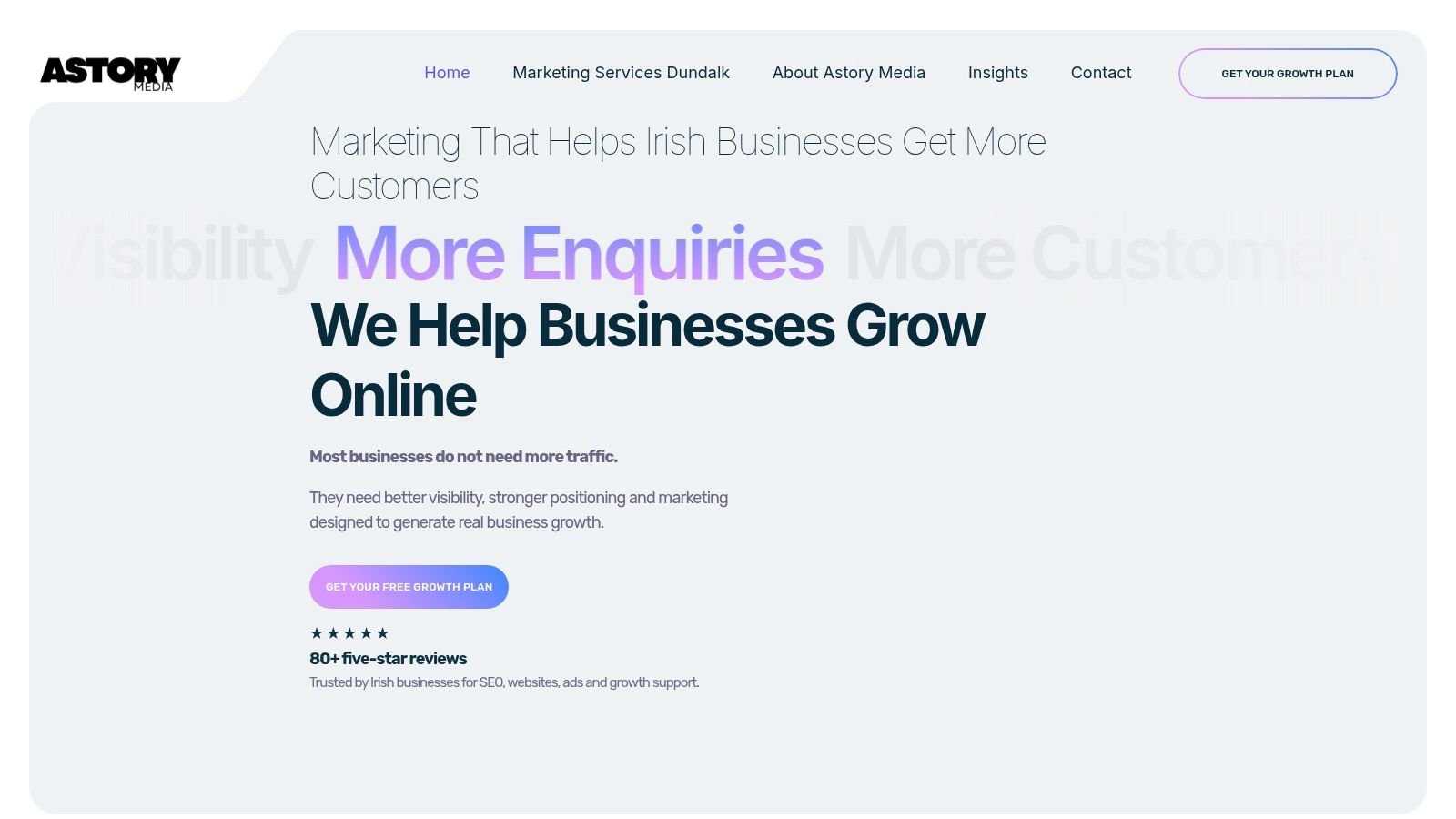
For Irish e-commerce agencies, the most impactful work is often conversion-rate optimisation, not just traffic growth. With Irish policy pushing SMEs toward e-commerce, the practical bottlenecks are checkout friction and mobile usability. Agencies that handle UX, speed, and analytics well can turn the same visitor count into more revenue, as noted in this e-commerce conversion overview.
Check the site like a buyer
Don't read an agency site like a fan. Read it like an investor.
Look for proof that they understand commercial performance. That means case studies, before-and-after site work, clear process, and signs they care about measurement instead of vanity.
Use this quick filter:
- Look for real work. Browse the agency's recent portfolio examples or equivalent. You want to see actual websites, actual categories, actual user journeys.
- Check whether results are concrete. Good agencies show business outcomes, what they changed, and why. Weak agencies hide behind phrases like “improved presence” or “enhanced brand awareness”.
- Read how they describe their process. If they can't explain discovery, tracking, implementation, testing, and review in plain English, execution will be messy.
- Inspect mobile. Open the site on your phone. If their own site is awkward on mobile, they shouldn't be touching your store.
- Study the call to action. Serious agencies usually invite a strategy conversation. Weak ones push hard for “book now” before giving you enough information to trust them.
The agency's own website is usually their best sales rep, or their loudest warning sign.
Red flags that kill deals
Here's what should make you leave fast.
| Red flag | Why it matters |
|---|---|
| Vague promises | If they promise “more visibility” without tying it to sales, they're avoiding accountability |
| No clear specialism | Generalists often stretch across too many channels and master none |
| Awards front and centre | Trophies don't fix checkout friction or poor tracking |
| No mention of analytics | If they don't talk about attribution, they won't know what's working |
| Pretty visuals, no commerce logic | A nice homepage means nothing if product discovery and checkout are weak |
A winner talks about bottlenecks, friction, testing, feed quality, landing pages, and conversion paths. A loser talks about creativity first and business impact later.
That doesn't mean branding is useless. It means branding without commercial execution won't save your store.
The Only Questions You Need to Ask an Agency
Most owners waste the first call asking two weak questions. How much does it cost? How soon can you start?
Ask better questions and bad agencies fold quickly.
A strong agency should be able to think on its feet, explain trade-offs, and show how it makes decisions. Not just what software it uses, but how it decides what to fix first. If they work with e-commerce seriously, they should understand campaign segmentation by brand, category, and SKU, align product feeds with inventory status, and connect bidding to commercial logic, as explained in this guide to large-scale e-commerce agency structure.
Ask about decision making
Don't ask whether they “do Google Ads”. Ask how they structure Google Ads when a retailer has multiple categories, mixed margins, and uneven stock.
Don't ask whether they “do CRO”. Ask what they would audit first on your mobile product page and checkout.
Don't ask whether they “send reports”. Ask what actions those reports trigger.
These are the questions that matter:
- What would you fix in the first month? Their answer should be prioritised. Not a long wishlist.
- How do you decide whether the bottleneck is traffic, conversion, or offer? This shows whether they can diagnose, not just execute.
- Who is doing the work day to day? You don't want to be sold by one person and passed to someone junior with no context.
- What metrics do you use to judge success? You want commercial metrics, not platform vanity.
- How do you handle product feed quality, campaign structure, and stock changes? This matters if you have multiple categories or fast-moving inventory.
- What needs to happen on our side for this to work? Good agencies know client delays kill momentum.
Ask for a recent example where they changed direction based on data. If they can't explain a decision clearly, they probably didn't make one.
Agency vetting checklist
| Question Category | Question to Ask |
|---|---|
| Strategy | What is your plan for the first 90 days? |
| Diagnosis | What do you think is most likely blocking growth right now? |
| Proof | Walk me through a recent client result and what you changed |
| Execution | Who will actually manage the account each week? |
| Reporting | What do you report on, and what decisions come from that report? |
| Paid media | How do you structure campaigns by brand, category, or product intent? |
| Website | What conversion issues do you normally find first on e-commerce sites? |
| Tracking | How do you make sure sales and leads are attributed properly? |
| Commercial fit | What type of store should not hire you? |
| Process | What do you need from us to move quickly? |
The last one is the killer question. Ask them what type of business should not hire them. Honest agencies answer directly. Desperate ones say they can help everyone.
E-commerce Agency Pricing Explained
Agency pricing confuses people because the invoice says one thing and the actual cost says another. You're not just paying fees. You're paying for decisions, speed, execution quality, and whether those things turn into profitable sales.
That's why “cheap” often costs more.
A lot of small business owners ask the wrong question. They ask whether an agency is affordable in the abstract. It isn't an abstract decision. The better question is whether the level of support matches your size, your order volume, and your margins. That's the point made in Bain's piece on serving small businesses properly. A one-person shop and a growing SME should not buy the same agency model.
The three pricing models you will see
Retainer
This is the most common model. You pay a monthly fee for ongoing work. It makes sense when you need continuous optimisation across ads, SEO, analytics, and site changes.
The upside is consistency. The downside is that weak agencies hide behind routine. They send the same report every month and call it momentum.
Project fee
This works for specific jobs like a Shopify rebuild, tracking setup, product page overhaul, or feed clean-up. Good if the problem is clear and contained.
The problem is that a project can fix the shopfront but leave growth untouched. A better site doesn't guarantee better sales if traffic quality and retention stay weak.
Performance or hybrid deals
These sound attractive because they seem aligned. Sometimes they are. Sometimes they create weird incentives, especially when the agency optimises for channel metrics instead of total business performance.
If you take this route, make sure the commercial definitions are clear. Revenue growth without margin discipline can still hurt you.
For businesses comparing site investment options, even a service page like affordable web design in Ireland can be useful as a reminder that “affordable” only matters if the build is conversion-focused and commercially sensible.
How to decide if it is worth it
Don't start with the fee. Start with your economics.
Ask yourself:
- What is our average margin after fulfilment and fees?
- Can we handle more orders operationally?
- Do customers buy once or come back?
- Is the current bottleneck traffic, conversion, or repeat purchase?
If margins are thin, retention is weak, and fulfilment is chaotic, a full-service retainer may be the wrong move. You may be better off with staged support. Fix the website first. Then tracking. Then paid search. Then email.
That's what smart e commerce agencies do. They don't force every business into the same package. They build a service ladder that fits the economics.
This short video gives a useful perspective on how owners think through agency spend and return before committing.
If your store can't convert current traffic, paying for more traffic is usually a tax on impatience.
The right agency fee should feel justified by a credible plan to improve the key numbers. If the plan is vague, the fee is too high at any price.
Your Next Move to Grow Your E-commerce Business
Stop thinking about hiring an agency as outsourcing marketing.
You're building a growth system. That system needs traffic, conversion, retention, tracking, and fast decision making. If one part is weak, the whole thing struggles. That's why the best e commerce agencies aren't random suppliers. They act like operators who care where revenue comes from, what blocks sales, and what needs fixing first.
Here's the blunt version.
Don't hire based on charm. Don't hire based on a polished proposal. Don't hire because they say they're full service. Hire the team that understands your margins, your buying journey, your category structure, your mobile experience, and your reporting needs.
Use a hard filter:
- They diagnose before they prescribe
- They talk in commercial terms, not platform jargon
- They can explain what happens in the first 90 days
- They show you who will do the work
- They tell you when a smaller engagement makes more sense than a big retainer
That last point matters. Not every business needs the full stack on day one. Sometimes the best move is a focused intervention that fixes the bottleneck and proves the economics before you scale.
A real partner won't try to sell you everything. They'll try to fix the right thing first.
If you're serious, build a shortlist, review the sites, ask the hard questions, and make agencies earn the deal. You don't need more noise. You need a system that turns attention into sales, and sales into repeatable growth.
If you want a team that thinks beyond vanity metrics and focuses on SEO, Google Ads, websites, and content as one growth engine, take a look at Astory Media. They work with Irish businesses that need more than a pretty website. They need enquiries, customers, and a digital setup that performs.
Refined using the Outrank app


