

Most advice on hiring SEO consultants is backwards. It tells you to compare packages, ask about rankings, and collect proposals. That's how businesses waste money.
If you start by shopping for “SEO”, you're already off track. You should be hiring for a business result. More phone calls. More booked jobs. More product sales. More profitable local traffic. Not a pile of audits, blog posts, and vague monthly reports.
That matters even more in Ireland. A business in Dundalk, Drogheda, Dublin, or Cork doesn't always have the luxury of funding a broad, open-ended marketing retainer and waiting patiently. Cash flow matters. Seasonality matters. Trust matters. A consultant who ignores that and sells you a generic 12-month SEO roadmap is selling their process, not solving your problem.
Table of Contents
- Stop Looking for SEO and Start Defining Your Mission
- What Good SEO Consultants Deliver And What They Don't
- How to Find and Filter Candidates Before You Talk to Them
- The Vetting Process Questions Red Flags and Your Checklist
- Hiring for the Irish Market A Dundalk Agency Perspective
- Finalising the Contract and Kicking Off for a Win
Stop Looking for SEO and Start Defining Your Mission
Typing “search engine optimization consultants” into Google before you know what you want is lazy buying. It feels productive. It isn't.
SEO is not the goal. Business outcome is the goal. Good SEO is just one route to get there. That's why two businesses in the same town should hire very different consultants. A Dundalk electrician needs calls and form leads. An online retailer needs category traffic that converts. A clinic needs trust-heavy service pages and qualified enquiries.
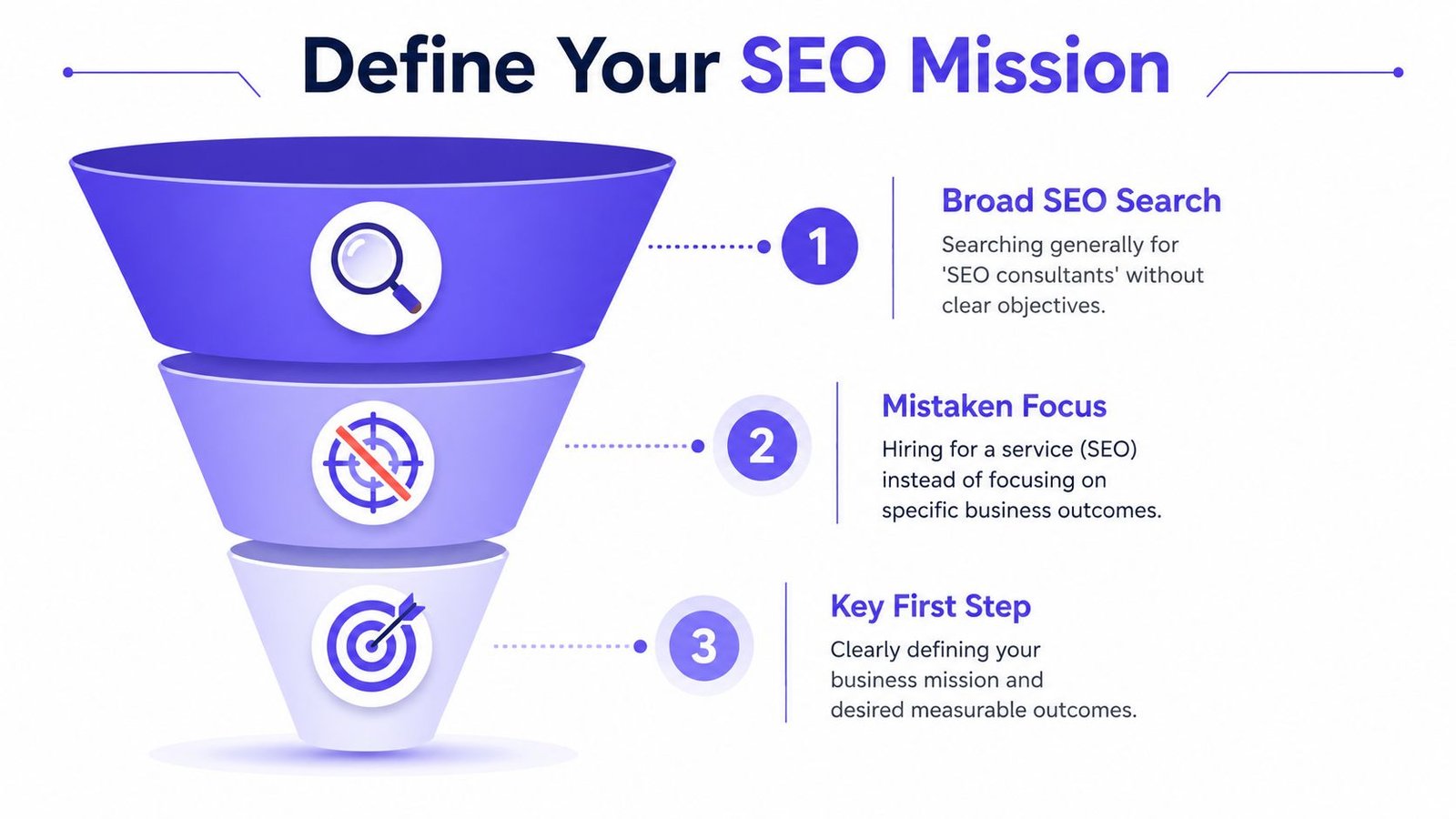
Pick one primary outcome
Don't give yourself five goals. Pick one primary outcome and one secondary outcome.
Use this simple decision filter:
- Lead generation business: prioritise phone calls, contact form submissions, and booked appointments.
- E-commerce business: prioritise sales from organic traffic and category or product page performance.
- Local retail or service business: prioritise map visibility, direction requests, and local landing page conversions.
- High-trust sectors: prioritise qualified enquiries, not raw traffic.
If a consultant starts talking about “getting you to number one” before asking about margins, sales cycle, or lead quality, they're not thinking like an operator.
Practical rule: If the outcome can't be tied to revenue, it shouldn't be the headline KPI.
Turn business goals into SEO targets
Here's the translation most businesses skip.
If your real goal is more booked jobs, the SEO target is not “rank higher.” The SEO target becomes:
- Get the right service pages indexed.
- Improve local intent visibility.
- Increase conversion actions from organic visitors.
- Track cost per lead and lead quality.
That changes the whole engagement. Now the consultant has to care about your site structure, your calls to action, your service area pages, your Google Business Profile, and your tracking setup. That's proper commercial SEO.
A well-run campaign can be worth the wait. Well-executed SEO campaigns can achieve positive return on investment within 6–12 months, with an average SEO marketing ROI of 22:1, according to SEO market stats from Xamsor. That's exactly why you need clarity up front. High-return channels still waste money when the mission is fuzzy.
Use this mission statement before you speak to anyone:
We need SEO to generate more [calls / leads / sales] from [location or audience] by improving visibility for [service or product category], and we will judge success using [conversions / cost per lead / revenue].
That one sentence will save you from a bad hire.
What Good SEO Consultants Deliver And What They Don't
Real SEO isn't magic. It's a system. If somebody sells you mystery, “secret methods”, or a special relationship with Google, walk away.
A proper consultant should show you a structured plan built around core services. Core services from SEO consultants include extensive keyword research, thorough technical audits evaluating site speed, mobile-friendliness, and URL structure, content planning, and local SEO solutions like optimising for local search queries and managing business listings, as outlined in this overview of SEO consultant services.
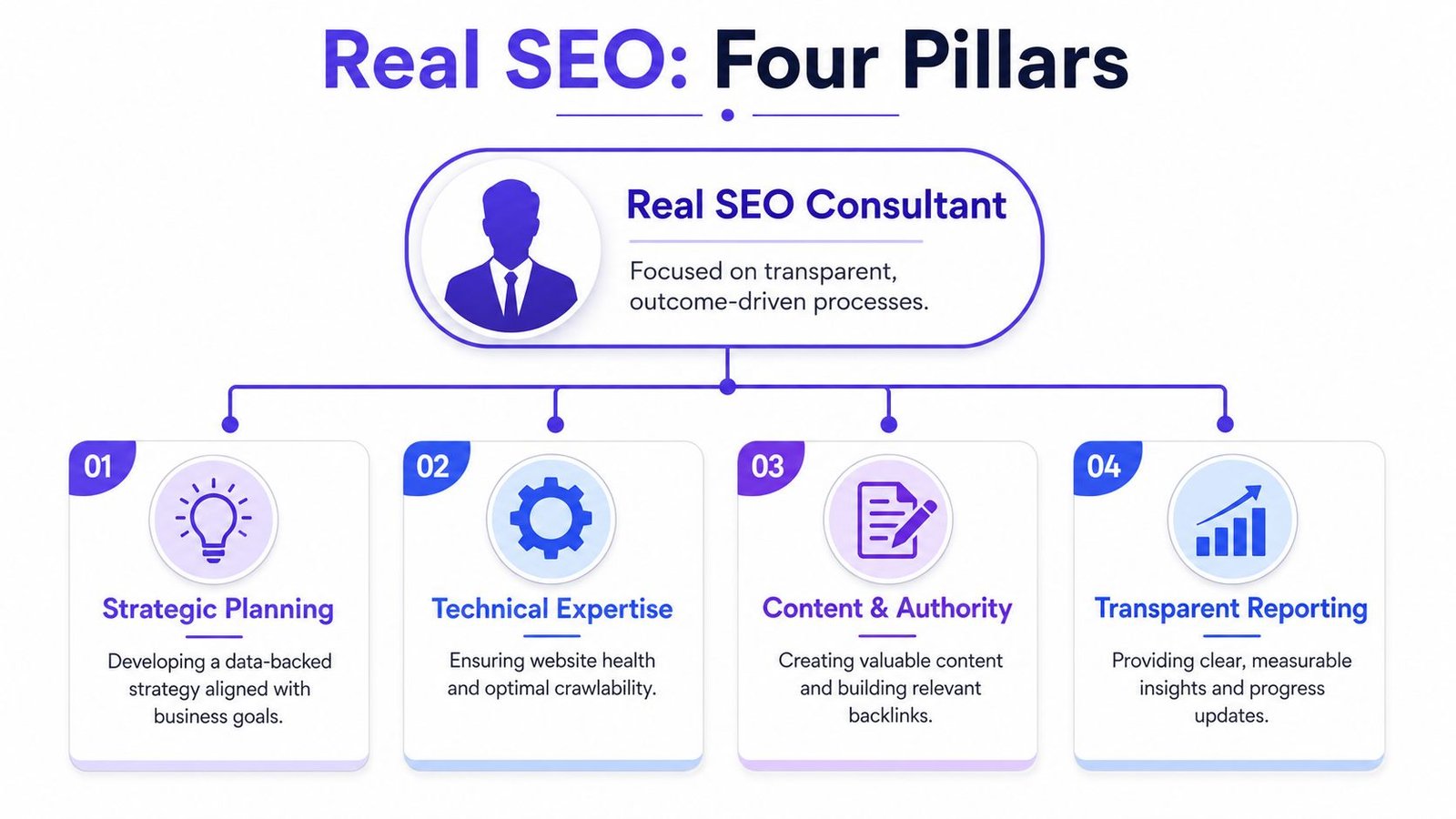
The four things worth paying for
1. Technical SEO
This is the plumbing. If your site is slow, messy, badly structured, or hard to crawl, the rest of the work gets weaker. A consultant should be checking Google Search Console, crawling the site with tools like Screaming Frog, reviewing page templates, internal links, schema, and mobile usability.
2. On-page optimisation
Pages match what buyers search for. Titles, headings, copy structure, internal links, service intent, and local relevance all matter. Not because it looks tidy. Because Google needs clear signals and visitors need clarity fast.
3. Content strategy
Content isn't “write blogs every week.” It's building the pages your buyers need at the moment they search. That might be service pages, location pages, category pages, FAQs, comparison pages, or trust pages. A good consultant knows the difference.
4. Off-page signals
This is authority and trust. Not spammy backlink packages. Not directory junk. Real off-page work includes reputation signals, citations where relevant, digital PR, and selective outreach. If you need a feel for what structured authority work looks like, review examples of link building services that focus on relevance and quality instead of volume.
Good SEO should be understandable. If they can't explain the work in plain English, they probably can't prioritise it either.
What stays on your side of the table
A consultant is not your entire growth engine. Some responsibilities stay with you.
- Approvals: You need to approve content, claims, offers, and service details.
- Commercial input: You know which jobs are profitable, which products have margin, and which areas you want more of.
- Sales feedback: You must tell the consultant which leads are rubbish and which ones close.
- Access and implementation support: Some fixes need your developer, website platform admin, or internal team.
This is also why local context matters. If you're focused on map visibility and service-area intent, a consultant should understand local SEO mechanics, including work similar to local SEO in Dundalk where pages, profiles, and local signals need to line up properly.
A proposal should include deliverables you can inspect. Think keyword plan, technical findings, content roadmap, implementation priorities, and reporting tied to business outcomes. If all you get is “monthly SEO services” with no shape to the work, that's not a plan. That's a standing order.
How to Find and Filter Candidates Before You Talk to Them
You don't need ten discovery calls. You need two or three serious contenders.
Start by narrowing the field hard. The easiest mistake is talking to anyone who shows up in search or sends a decent cold email. That only creates noise.
Filter first, talk later
Build a shortlist using signals you can verify fast:
- Relevant market fit: Have they worked with service businesses, retailers, clinics, or e-commerce brands like yours?
- Clear service pages: Can they explain what they do without hiding behind jargon?
- Proof of process: Do they show audits, examples, reporting style, or strategy thinking?
- Analytics maturity: Do they talk about conversions, attribution, and business outcomes instead of vanity metrics?
That last point matters more than most owners realise. If a provider is weak on measurement, you'll never know whether the work is paying off. If you want a sharper lens on that side, this guide on how to evaluate marketing analytics providers is worth reading before you shortlist anyone.
What to check before the call
Open their website and look for signs of discipline.
Check whether their pages are clear, fast, and built around intent. Read their service pages. Are they written for buyers or padded for search engines? Look at their blog or resources. Are they publishing useful explanations, or just churning out fluff?
Then check the evidence they choose to show. A decent case study should connect work to business movement. If they only talk about impressions, rankings, or traffic with no commercial context, that's weak.
Use this pre-call checklist:
- Read their proposal style from the site: If their own messaging is vague, expect vague reporting.
- Look for practical specificity: Tools like Search Console, GA4, Screaming Frog, Lighthouse, schema work, local listings, and content mapping should come up naturally.
- Review testimonials carefully: You want signs of communication, honesty, and execution. Not just “great team”.
- Check whether they teach: People who understand the work can explain it.
This video gives a useful outside perspective on what to screen for before you hire.
Don't overcomplicate this stage. Your job is not to crown a winner yet. Your job is to remove weak options quickly.
The Vetting Process Questions Red Flags and Your Checklist
The interview is where most business owners go soft. They ask polite questions, get polished answers, and pick the consultant they liked most. That's amateur behaviour.
You need to stress-test how they think.
Google is blunt on this. Google's official guidance warns businesses against vendors who guarantee number-one rankings, claim a “special relationship” with Google, or use opaque tactics, and it recommends asking for examples and checking references, as explained in Google's SEO hiring guidance.
Questions that expose real skill
Ask these directly.
“Walk me through your first 90 days for my business.”
Good answer: they talk about audit, tracking, quick wins, structural fixes, priority pages, local signals, and sequencing.
Bad answer: they jump straight to link building or blog posting.
“What would you measure if you were accountable for revenue, not rankings?”
Good answer: conversions, lead quality, landing page performance, local intent visibility, and reporting tied to outcomes.
Bad answer: “we mainly focus on keyword movement.”
“What do you need from us to make this work?”
Good answer: access, sales feedback, approval workflows, implementation speed, commercial priorities.
Bad answer: “nothing really, we handle it all.”
“Where do SEO campaigns usually stall?”
Good answer: slow implementation, weak content approvals, bad tracking, poor site structure, internal bottlenecks.
Bad answer: “if you follow our system, they don't.”
The right consultant won't just talk about tactics. They'll talk about dependency, sequencing, and trade-offs.
If you're comparing niche providers, it can help to see how more technical buyers assess fit. For example, this piece on SaaS SEO agency selection is aimed at software companies, but the evaluation logic is solid for any business owner.
Red flags that should end the conversation
Some answers don't deserve a second meeting.
- Guaranteed rankings: Nobody credible can guarantee that.
- Opaque methods: If they “can't reveal the process”, they either don't have one or you won't like it.
- No references or examples: That's a trust problem.
- No interest in tracking: Then they're asking you to fund guesswork.
- One-size-fits-all plan: Your business is not a template.
- Lock-in contracts with fuzzy deliverables: That's how weak providers protect revenue.
For local businesses, also ask how they handle Google Business Profile work, local landing pages, and trust signals. If they need a baseline, even a simple resource like this Google Business Profile optimisation checklist for Ireland shows the kind of practical local detail they should be comfortable discussing.
SEO Consultant Comparison Checklist
Stop relying on gut feel. Score them.
| Criterion | Consultant A | Consultant B | Consultant C |
|---|---|---|---|
| Understands my business model | |||
| Asked about margins and lead quality | |||
| Explained first 90 days clearly | |||
| Focuses on conversions, not vanity metrics | |||
| Clear on technical, content, and local priorities | |||
| Transparent about dependencies and risks | |||
| Provided relevant examples and references | |||
| Communicates in plain English | |||
| Contract terms feel fair and inspectable | |||
| I trust them to tell me bad news early |
Blunt test: If you can't explain why you chose them without using the words “seemed nice”, don't sign yet.
Hiring for the Irish Market A Dundalk Agency Perspective
A consultant can be brilliant at SEO and still be wrong for your business.
That happens when they import a generic playbook into an Irish SME without adjusting for reality. It is simple: Budgets get squeezed. Demand can swing by season. Owner attention is split across operations, hiring, suppliers, and collections. A consultant who acts like every company can fund a smooth long-term programme from day one is detached from how many businesses operate.

Cash flow changes the plan
This is where local judgement matters. Around 40% of Irish SMEs report cash flow as a major challenge, which means SEO plans often need to align with quarterly or seasonal budget cycles, according to this Irish SME cash flow context.
That should shape the work.
A smart consultant may front-load technical fixes, core service page improvements, conversion tracking, and local page clean-up first. Those are often the most impactful actions. Then they stage heavier content production or broader expansion once early gains and internal capacity improve.
For a business comparing providers, one local option in the market is SEO services in Dundalk, where the work spans technical fixes, on-page improvements, content planning, and local optimisation. The key point isn't the provider name. It's whether the plan matches your trading reality.
Local trust signals are not optional
Irish buyers don't just scan for price. They scan for legitimacy.
That means your SEO consultant should care about things many generic providers ignore:
- Privacy clarity: your privacy notice, cookie handling, and contact details should be easy to find and easy to understand.
- Accreditation signals: memberships, certifications, and professional registrations should support trust on the page.
- Local proof: service areas, reviews, local imagery, and clear business identity should line up across the site and profile assets.
- Sector-specific reassurance: clinics, cosmetic providers, finance firms, and high-ticket retailers need stronger trust framing than a standard brochure site.
If a consultant treats trust as “just get more reviews”, they're thinking too narrowly. In Ireland, trust and conversion are tied together tightly. Local SEO without trust optimisation leaves money on the table.
Finalising the Contract and Kicking Off for a Win
The hire isn't done when you say yes. It's done when the scope is clear, access is clean, and both sides know what happens next.
That matters because SEO is no longer a side project. The market itself shows where things are heading. The global search engine optimization services market was valued at USD 94.0 billion in 2025 and is projected to grow at a CAGR of 16.44% through 2033, according to IMARC's SEO services market outlook. Businesses are treating this as a strategic function. You should too.
What the contract must say
Your agreement should define:
- Scope of work: what they will do each month
- Deliverables: audits, implementation priorities, content briefs, reporting, meetings
- Access boundaries: who gets access to GA4, Search Console, CMS, and listings
- Communication rhythm: who speaks to whom, how often, and in what format
- Exit terms: notice period, handover obligations, and ownership of work
If the contract locks you in while keeping deliverables vague, don't sign it.
How to start without chaos
Kickoff should be operational, not ceremonial.
Use this onboarding list:
- Grant the right access: analytics, Search Console, CMS, tag manager, and profile access as needed
- Confirm one owner on your side: too many approvers kills momentum
- Agree the 30-60-90 day plan: priority fixes first, not random activity
- Define success early: conversion actions, reporting format, and decision cadence
- Set implementation rules: who pushes changes live and how fast
A strong kickoff should leave no confusion about priorities, dependencies, or what success looks like in the first phase.
If you want a team that understands SEO, websites, ads, tracking, and the practicalities of selling in Ireland, talk to Astory Media. They're based in Dundalk and work across local search visibility, conversion-focused websites, paid traffic, and content, which makes them a practical fit for businesses that need enquiries and sales, not disconnected marketing activity.


