
In Ireland, a realistic budget for a small business website starts around €695 to €1,500 + VAT for a simple brochure site, but if you want a professional business website that can support growth, expect €1,500 to €3,500 + VAT. That's the bracket most owners should use as their baseline, because cheap websites usually leave out the parts that make the site useful.
Most advice on affordable web design in Ireland is weak. It treats price as the main decision. It isn't. The real question is whether the website brings in calls, form enquiries, bookings, or sales. If it doesn't, it wasn't affordable. It was a waste of money.
Small business owners get burned in two ways. They either overpay for fluff they don't need, or they underpay for a site that looks fine and performs badly. Both hurt. A profitable website sits in the middle. It's tightly scoped, built for mobile, structured for search, and designed to push the visitor towards one clear action.
That's how you should buy a website in 2026. Not as a design project. As a business asset.
Table of Contents
- The Real Price of Web Design in Ireland
- Your Three Options Freelancer Agency or DIY
- The Unbreakable Checklist Before You Hire Anyone
- Smart Ways to Save Money That Actually Work
- Does Your Affordable Website Make You Money
- Your Next Step
The Real Price of Web Design in Ireland
Cheap web design is rarely affordable. It often costs more because it fails to bring in leads, needs rebuilding within a year, or locks you into a site you cannot improve.
Price matters. Return matters more.
What Irish businesses pay
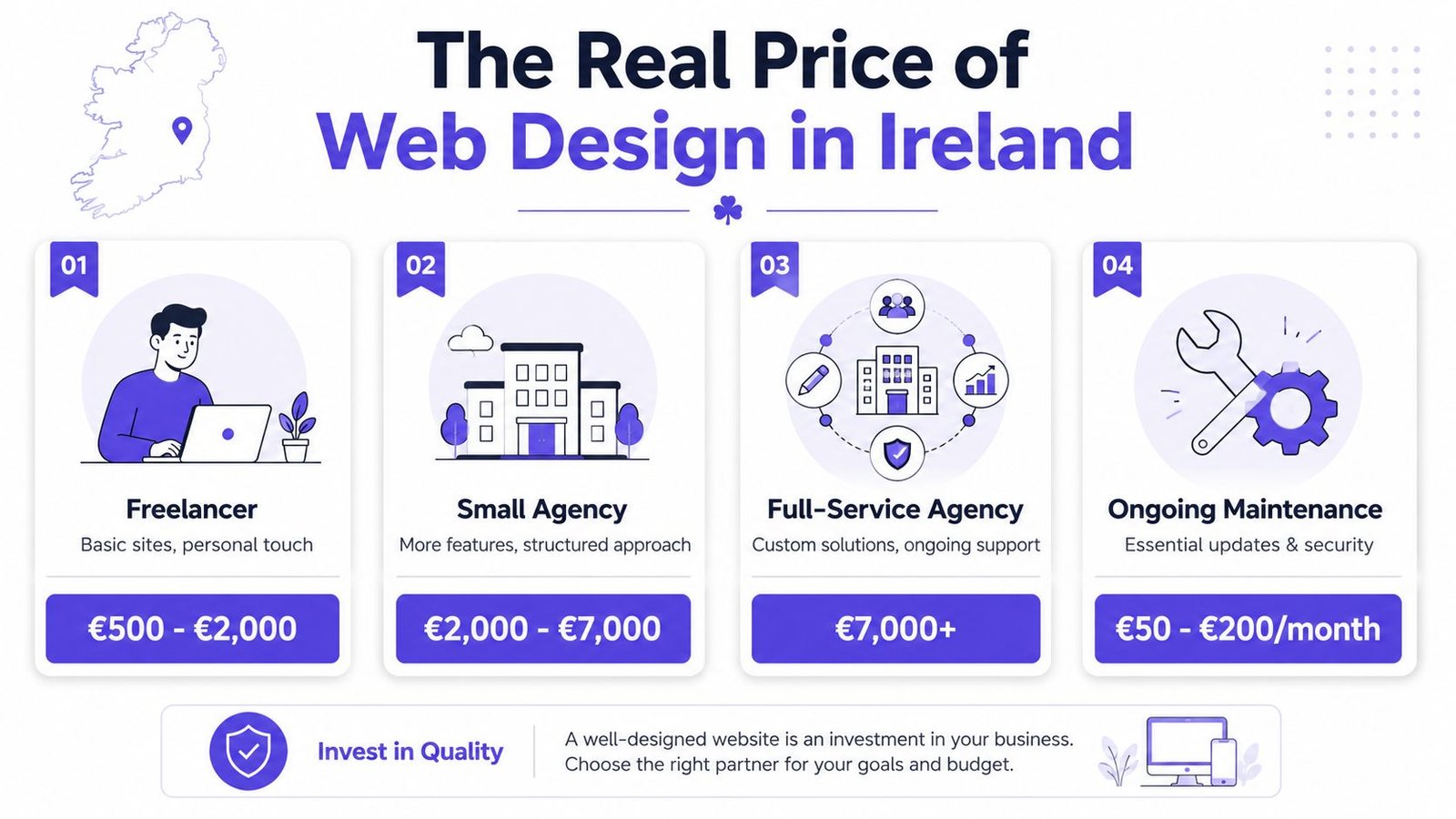
A simple brochure site in Ireland is often quoted at €695 to €1,500 + VAT, a professional business site at €1,500 to €3,500 + VAT, and an e-commerce store at €995 to €5,000 + VAT, based on Irish website cost benchmarks. The same source notes that first-year totals can reach €1,500 to €4,000 + VAT once content, SEO, and standard add-ons are included.
If you expect a sales-focused website for a few hundred euro, reset that expectation now. That budget usually buys a stripped-down starter site or a quote that hides the missing work until you are too far in to walk away.
Use this as a sanity check:
| Website type | Realistic Irish price range | Who it fits |
|---|---|---|
| One-page or very basic starter site | €300 to €800 | New businesses with one service and one clear call to action |
| Small brochure site | €695 to €1,500 + VAT | Businesses that need a credible online presence |
| 5 to 10 page small business site | €1,000 to €3,000 | SMEs that need service pages, trust signals, and a clear enquiry path |
| Professional business website | €1,500 to €3,500 + VAT | Businesses that want the site to support growth |
| E-commerce website | €995 to €5,000 + VAT | Shops selling online with checkout and product setup |
Low quotes are not a win by default. They often exclude copywriting, SEO setup, conversion-focused page structure, image sourcing, revisions, training, maintenance, or even basic analytics.
High quotes need scrutiny too. If the extra spend does not improve lead quality, sales process, speed, or long-term control, it is just expensive packaging.
Practical rule: If a quote looks cheap, assume something important has been removed until the provider proves otherwise.
What changes the price fast
Scope drives cost. Small changes on paper can create hours of extra work behind the scenes.
Prices rise when you add custom page layouts, stronger calls to action, better copy, booking systems, quote forms, CRM connections, SEO groundwork, analytics setup, or online payments. Mobile-friendly layouts, contact forms, and performance work also push a site beyond bargain pricing because they take planning and testing, not just design.
That is why “affordable” needs a better definition. A profitable website is one that does a specific job well, gets found, builds trust, and gives visitors a clear next step.
If you need a clean service site that loads fast and turns visits into enquiries, keep the brief focused and the build simple. If you want custom features, a larger sitemap, and conversion work across multiple pages, expect the budget to rise.
That is normal.
A smart buyer cuts waste, not the parts that make the phone ring. If you want to see what that looks like in practice, review examples of small business website design in Dundalk and compare the scope to what your business needs right now.
Your Three Options Freelancer Agency or DIY
Cheap is not the goal. Return is.
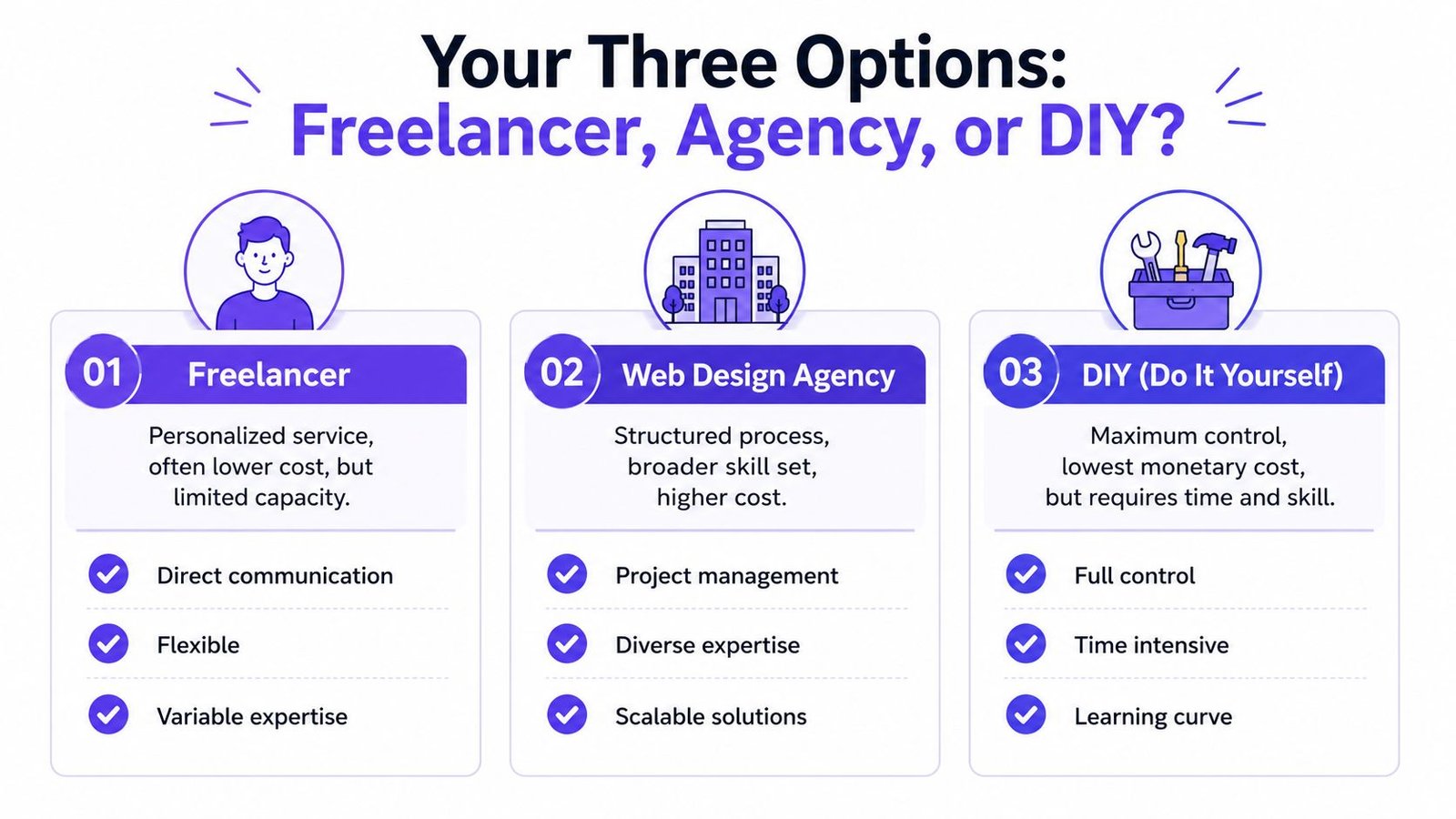
You have three primary routes. Hire a freelancer, hire an agency, or build it yourself. The right choice depends on how much revenue the site needs to produce, how fast you need it to work, and how much risk you can afford to carry.
A freelancer usually costs less upfront. An agency usually costs more because you are paying for more than design. You are buying process, wider skill coverage, clearer accountability, and post-launch support. DIY looks cheapest on paper, but it often burns the most time and creates the weakest sales asset.
When a freelancer makes sense
Hire a freelancer when the job is narrow and you can give clear direction.
This works best for a small brochure site, a simple service business website, or a first proper online presence where the structure is obvious and the features are basic. You should already know what pages you need, what the offer is, and what you want visitors to do next.
Choose a freelancer if:
- Your scope is tight: Core pages, contact form, no custom systems, no complex integrations.
- You can manage the project: You can review drafts, supply content, and make decisions quickly.
- You need speed and flexibility: One good operator can move fast without layers of meetings.
For many owner-managed firms, this is the sensible starting point. If you are comparing options for small business website design in Dundalk, you will see plenty of businesses begin here because the site needs to be useful first, not bloated.
When an agency is the right call
Use an agency when the website has to pull its weight in the sales process.
If the site needs to generate enquiries, rank locally, track conversions, support campaigns, or connect with other tools, a solo build starts to strain. You need design, development, messaging, SEO input, analytics, testing, and someone who can spot expensive mistakes before launch.
Use an agency if:
- You need lead generation: Calls, quote requests, bookings, or online sales need a clear system.
- You need several skills at once: Design alone will not carry the job.
- You want continuity: Updates, fixes, reporting, and improvements matter after launch.
Here is the hard truth. If online enquiries matter to the business and nobody on your side understands conversion, search, and user behaviour, paying more for stronger execution is often cheaper than fixing a weak site six months later.
Watch what they focus on. A provider who talks only about colours, fonts, and layouts is selling decoration. A provider who asks about margins, lead quality, close rates, and tracking is thinking like a commercial partner.
When DIY is a mistake
DIY suits a test project, a side venture, or a business owner who has time to learn and the patience to do the work properly.
It does not suit a company that needs credibility, enquiries, and momentum now. Building your own site means handling structure, copy, mobile layout, images, forms, basic SEO setup, and ongoing fixes. Most business owners either rush those jobs or leave them half-finished.
A DIY site is not free. You pay with time, lost leads, and problems you do not notice until the site underperforms.
If the website is supposed to help the business grow, judge each option by profit, not sticker price. The lowest quote wins the wrong competition.
The Unbreakable Checklist Before You Hire Anyone
Cheap websites fail long before launch. They fail in the sales conversation, when nobody defines what the site must produce for the business.
Set that target first. More calls. More quote requests. More bookings. More sales. If a provider cannot tie the build to one of those outcomes, you are buying a design project, not a business asset.
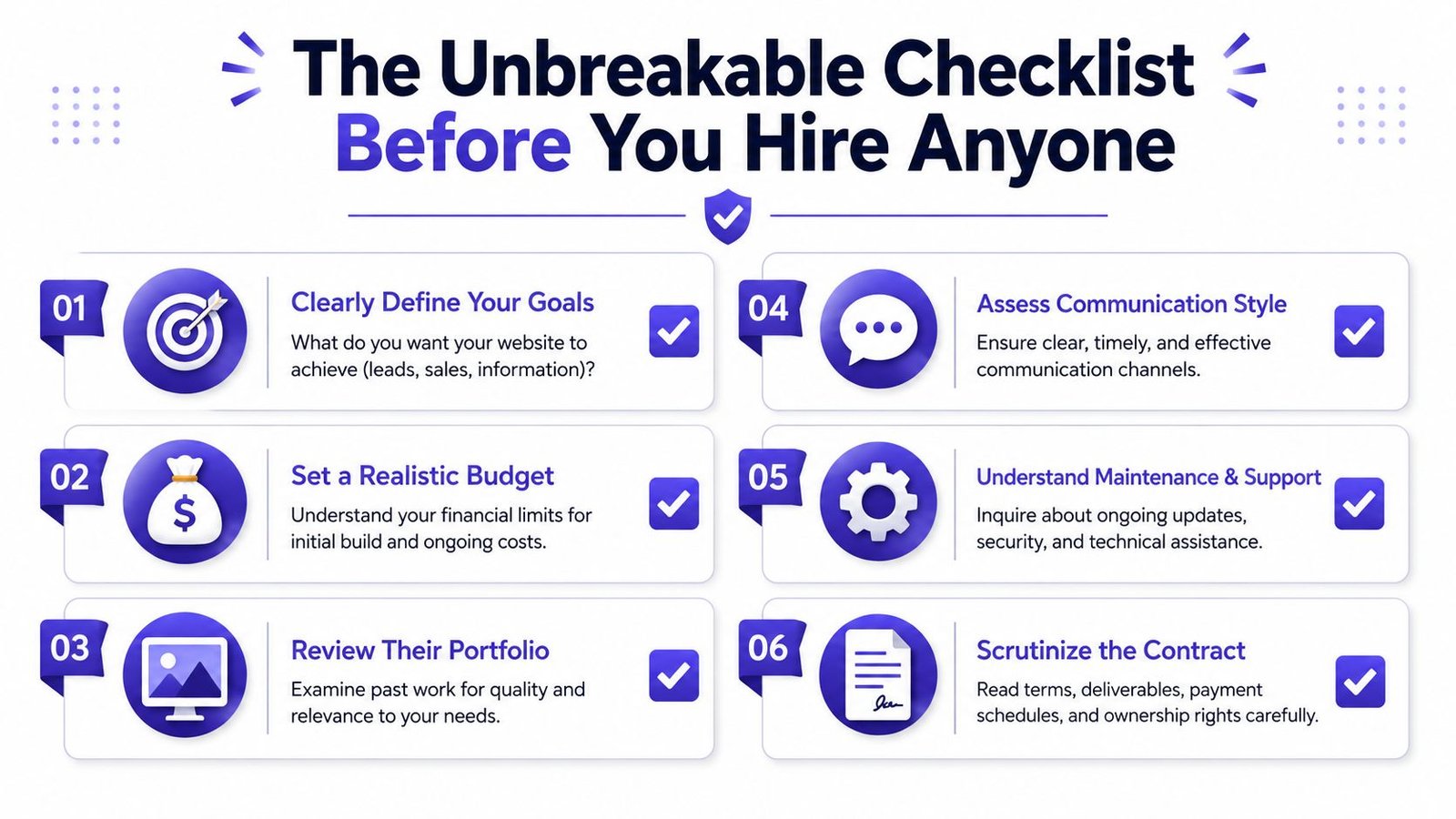
Ask these questions before you spend anything
Ask direct questions. Then listen for precision.
What should each key page make the visitor do?
Every important page needs one clear next step. Call. Fill in a form. Request a quote. Book an appointment. Buy. If they talk about making pages “look clean” before they talk about actions, they are focused on appearance over results.
Who is the site built for?
A clinic needs trust and clear service explanations. A trades company needs fast contact paths and local proof. A retailer needs product structure and checkout clarity. If the provider gives the same plan to every business, expect a generic site.
What pages are required to win business?
You usually need a homepage, focused service pages, an about page, contact details, location information, reviews, and answers to common objections. Extra pages add cost and confusion unless they support a sale.
How will the mobile version be planned?
Planned matters. A site should be designed for phones from the start, not squeezed down at the end. Local buyers often find businesses through search and maps on mobile, so your site also needs a clear connection to your Google Business Profile optimisation checklist for Ireland.
What SEO groundwork is included before launch?
You want page titles, heading structure, indexable service pages, internal links, local intent in the copy, and a sensible site structure. If SEO is treated as an afterthought, you will pay twice.
Who owns the site and what happens after launch?
Get a straight answer on hosting, updates, backups, fixes, logins, domain access, and admin access. If ownership sounds blurry, walk away.
One more question exposes sloppy providers fast. Ask who is responsible for content, images, and deadlines. Projects drift when nobody owns those jobs, and drift costs money.
If you are supplying photos, send web-ready files, not giant originals from a phone or camera. Use this guide to proper image dimensions for websites before anything gets uploaded.
Ask for deliverables in writing. Pages, features, revisions, timelines, ownership, and support. Verbal promises are how cheap projects become expensive.
What a proper process looks like
A brochure site usually takes several weeks because competent providers do the work in the right order. They start with goals and structure. They map the pages. They shape the content and calls to action. Then they build, test, and fix what breaks.
A weak provider skips straight to mockups. That feels fast. It also creates rework, muddled messaging, and pages that look finished but do not convert.
Hold them to a process like this:
-
Discovery
They ask about services, margins, location, customer type, and the enquiries you want more of. -
Sitemap
They decide what pages the site needs and how visitors move between them. -
Wireframes
They place headlines, proof, forms, and calls to action before polishing colours and visuals. -
Build
They develop the site to work properly across phones, tablets, and desktops. -
Testing
They check forms, links, speed, layout, browser compatibility, and tracking before launch.
Use these response standards when you interview providers:
- Timeline: You want named phases, deadlines, and approval points. Avoid anyone promising speed without a plan.
- Mobile design: You want mobile layouts considered from day one. Avoid vague claims that it will “adapt.”
- SEO setup: You want core on-page setup included in the build. Avoid providers who push every search task into a separate upsell.
- Testing: You want pre-launch checks across devices and browsers. Avoid anyone planning to fix issues after the site goes live.
- Content: You want clear responsibility for writing, editing, uploads, and sign-off. Avoid “we’ll figure it out later.”
Strong buyers do not need web jargon. They need standards. If a provider cannot answer simple commercial questions clearly, they will not build a site that earns its keep.
Smart Ways to Save Money That Actually Work
You can cut website costs without wrecking the result. Most businesses just cut the wrong things.
Cut waste not essentials
Don’t slash the parts that affect enquiries. Cut the avoidable labour.
Write your core service information before the project starts. Gather your logo files, brand colours, opening hours, service areas, and contact details in one place. Pick your photos early. If you hand a designer a mess, they bill you to organise it.
A pre-built theme can also be a smart choice if the provider customises it properly. You don’t need a fully bespoke design to win work. You need clear messaging, strong page structure, and a clean path to contact.
Images are another easy place to waste budget. Oversized files slow pages down, but poor-quality images kill trust. If you’re preparing content yourself, this guide on proper image dimensions for websites is worth reviewing before upload.
Use local visibility tools wisely too. For many service businesses, a well-set-up Google profile does more work than another round of homepage edits. This Google Business Profile optimisation checklist for Ireland is a practical place to tighten that side of the funnel.
Spend less on decoration. Spend more attention on clarity, speed, and the next step you want the visitor to take.
Think in 12 month cost not launch price
The launch quote is only part of the bill.
A major hidden cost is the full spend over the first year. DIY platforms in Ireland often come with recurring monthly fees of €12 to €35+, while low-cost builds frequently leave out hosting, security, and maintenance, according to this guide to website costs in Ireland.
That means the smart question isn’t “what does the build cost?” It’s “what will I spend over 12 months, and what’s included?”
Ask these before signing:
- What recurring costs apply: Hosting, domain renewal, email, plugin licences, maintenance.
- What support is included: Small edits, fixes, updates, backups, security.
- What happens if the site breaks: Who handles it, how fast, and what it costs.
Cheap upfront pricing often wins because buyers stop reading after the first number. Don’t do that.
Does Your Affordable Website Make You Money
Cheap web design is expensive when the site fails to produce enquiries.
That is the test. If your website does not generate calls, form submissions, bookings, or sales, the price was wrong, no matter how low the quote looked.
Your website has one main job
Your website is a sales tool. Treat it like one.
Visitors make a decision fast. They need to understand what you offer, where you offer it, why you are credible, and what they should do next. If your homepage hides that behind vague slogans, sliders, stock photos, or clever wording, it is costing you business.
Use this four-point check:
- What do you do
- Where do you do it
- Why should I trust you
- What do I do next
Miss one, and conversion drops.
Many low-cost builds fail. They give you pages, not a buying path. The layout looks fine. The message is weak. The calls to action are buried. The forms ask for too much. There is no tracking, so nobody can tell what is working.
A website without measurement is just a guess with a domain name.
What to build if you want leads
Profitable websites are usually simple. They are just built with discipline.
Start with clear service pages written around buyer intent. Put the main call to action near the top of the page. Keep forms short. Make the phone number tap-to-call on mobile. Show the areas you serve. Use proof that matters to a buyer, such as reviews, case studies, before-and-after examples, turnaround times, or clear pricing signals.
If you need a solid reference for page structure, LeadBlaze’s website template guide is useful because it focuses on lead flow instead of design trends.
Traffic and conversion need to work together. A polished site with no visibility will sit there doing nothing. A busy site with poor conversion will waste clicks. That is why many small businesses pair a rebuild with local search work such as SEO services in Dundalk, so the website gets found by people already looking for the service.
Astory Media is one example of an Irish agency that combines website design, SEO, Google Ads, tracking, and media production under one roof. That setup matters when you want the site tied to enquiries instead of treated like a standalone design project.
Stop calling a website affordable if it cannot prove its value. A profitable website pays you back. A cheap one gives you another bill.
Your Next Step
You don’t need the cheapest website. You need the simplest website that does the job properly.
That means a clear offer, focused pages, strong mobile experience, local search basics, and one obvious next step for the visitor. It also means buying with your eyes open. Understand the build cost. Understand the yearly cost. Understand who owns what, who maintains what, and how success will be measured.
Most business owners make this harder than it needs to be. They compare visual style before they compare business logic. Reverse that. Ask how the site will generate enquiries. Ask how it will be structured. Ask what happens after launch.
Then buy the version you can afford to run, improve, and measure.
If you want a website that’s built to generate enquiries instead of just filling space online, talk to Astory Media. The work covers website design, SEO, paid search, tracking, and content, so the site can function as part of a real growth system rather than a standalone brochure.


